

🔶 #80: "Can public media build its own social network?"
Hello and welcome back to the News Alchemists newsletter!
It's one of those weeks: little time to write, and nothing that interesting to say in this introduction that would be worth your time.
But there is one quick thing I wanted to ask you before we move to the seven links:
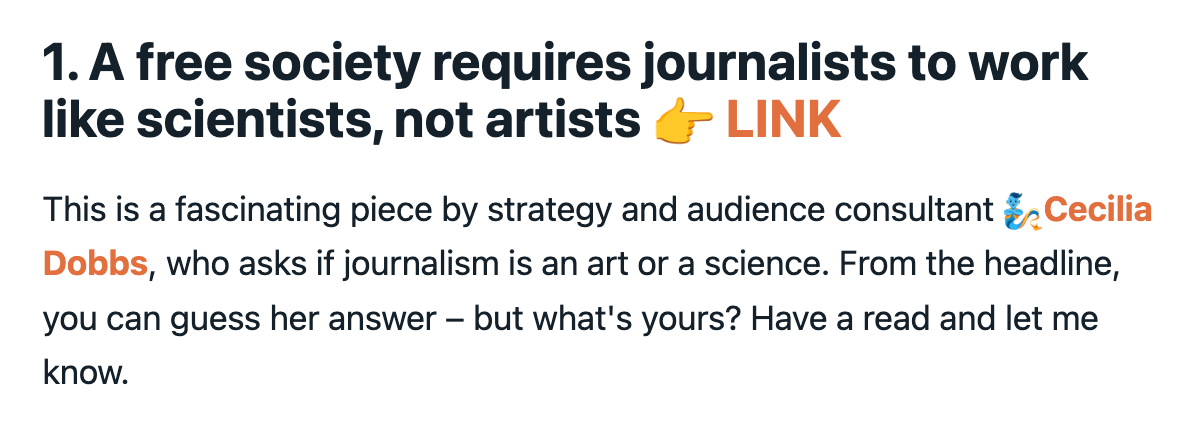
You might have noticed that, in the last few editions, I changed up the look-and-feel of the seven links.
They used to look like this:
Now they look like this:
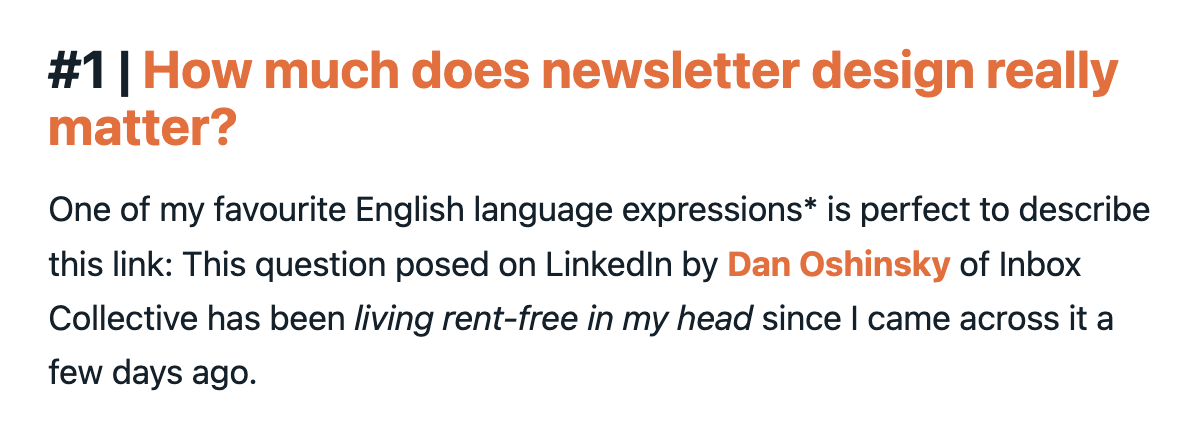
I had reasons to change the format, but I don't know if the new one is actually better. So, the question is simple: Which format do you prefer?
Scroll down to the end of the email and give me a thumbs-up if you prefer the new format or thumbs-down if you liked it more before.
Alright, let's go. Seven new links, bringing the total to a prime four hundred and twenty-one.
Enjoy and see you next week 👋
#1 | Can public media build its own social network?
I still don't know the answer, but Chicago Public Media is the latest news organisation that decided to give it a try – after others already featured in this newsletter, like Village Media in #7 (fifth link), Daily Maverick in #59 (third link), and Rappler in #62 (fourth link) – and I'll be interested to follow this experiment.
CEO 🧞Melissa Bell: “If you think about the idea of a newspaper 30 years ago, it was news but it was also local information. We would look for the movie listings in the advertising section…You would have letters to the editor. You would have local businesses telling you what was happening that weekend. I think that bundle idea is what we are trying to recreate, but just in a format that makes sense for today.”
#2 | Why knowing more about your readers is your newsletter’s next unfair advantage
Tired of the marketing funnel? 🧞Dan Oshinsky has an alternative: the user ladder. Same thing but upside-down? Not exactly: "The marketing funnel is designed to help your reader learn more about you. The user ladder is designed to help you learn more about your reader."
As usual with Inbox Collective articles, you won't find only the theory but also a set of very practical suggestions on how you can collect more information to get to know your readers.
#3 | What we learned in the first 3 months with a registration wall
An insightful piece written by 🧞Michael Donohoe, chief product officer of 🧩 Rest of World, aka one of the most beautiful websites in news. If you think that "deliberately introducing friction into a product where reach matters" seems counterintuitive, you will enjoy this read.
#4 | From a WhatsApp button to elTOQUE’s conversational infrastructure
How a chatbot helped 🧩 elTOQUE evolve the relationship with its audience from consumption to service. Interesting.
#5 | How audience interviews surface opportunities for service-oriented journalism
A good complement to Link #2, with useful tips to set up 1-on-1 interviews with members of your audience and to pick the right questions to ask. By 🧞Patrick Boehler and 🧞Madison Karas.
#6 | Five ideas of article formats where form follows function
"User needs, personalization, dynamic experiences… The move to being more audience-centric is (finally) happening! But what about the article itself? Despite so many innovations across publishing products, articles still tend to look the same as they always have – very text-heavy and focused on form-over-function. What we really should be doing is flipping this on its head, considering first and foremost the function of the article, and adapting the form accordingly. [...] Here are 5 examples."
By 🧞Madeleine White in Audiencers.
#7 | Please learn how to use your computer
I know, this has nothing to do with being people-centric or reimagining journalism... But when I found this rant plea by 🧞Joe Amditis in 🧞Sarah Alvarez's News Fix newsletter, I knew I had to share it anyways.
"The number of professionals in journalism, media, communications, and academia who still don’t understand how to use the very tools they depend on for their livelihood is, frankly, staggering."

And the most clicked link from the previous edition is... 🥁
The only link of the previous edition, very worthy of a re-share:
 Peter Erdelyi
⇲ The LinkedIn Corner
A section of this email in which I highlight LinkedIn posts written by newsletter readers that, for different reasons, may not make it to the main section, but are still interesting to share. Last week...
- Diego announced the launch of the Informed Climate Journalism Network, a training programme that empowers reporters and editors in telling the climate story.
- For my Italian readers: Giulia announced that applications are now open for FACTA Lab: Environment Uncovered, an opportunity to strengthen your skills in environmental investigative journalism – which includes a module on audience engagement with yours truly 🙋♂️.
- Megan and Andrew announced (lots of announcements, yes) Embodied Media, a project designed to reconnect us with ourselves, with others, and with nature.
- As for me, I had nothing to announce, but I wrote about the rewarding project I recently wrapped up with The Chronicle of Philanthropy, helping reorganise the Chronicle's entire newsletter portfolio and enhance its email strategy.
🌱 Do you need help growing your media product? I'm your coach.
⚙️ Looking for help with newsletter strategy, audience research, or project management? Let's work together.
🤗 Enjoy this newsletter? Forward it to someone you think might like it too.
Member discussion