

5 min read

πŸ”Ά #74: "What does it mean to be indispensable to audiences in the age of AI?"
Hello, and welcome back to the News Alchemists newsletter!

And a first welcome to new subscribers from MDIF, The 19th, and all of you brave souls working independently.

It's not always easy to curate a collection of seven links that are not only valuable when taken individually, but also work well together as an ensemble.

Sometimes you just have to trust that readers will find what is useful for them... and ignore the rest. But other times, the curation does work out beautifully – and that's very satisfying.

Today is one of those times. Even just by scanning the headlines of the seven links, you can see they each carry one of the keywords that somehow define this space we share each week: audiences, newsletters, impact, community, design, subscription, learning.

I hope you find at least one that speaks to you. And if you do, let me know which one it is through the poll you'll find at the end.

See you next week πŸ‘‹

P.S.: Thanks to everyone who joined the is-journalism-an-art-or-a-science debate last week! Super interesting to read all your takes on it.


#1 | What does it mean to be indispensable to audiences in the age of AI?

"If our goal is impact, we are unlikely to achieve it with paraphrased snippets in an AI Overview. Only deep, hard-earned relationships with our audiences will yield the effect we want.

So how do we nurture those direct relationships? Through consistent delivery of indispensable value that goes well beyond providing information. There are many types of value we can deliver, and I’ve tried to place them into a rough hierarchy β€” a β€œladder” that climbs from the more concrete to the more abstract:"
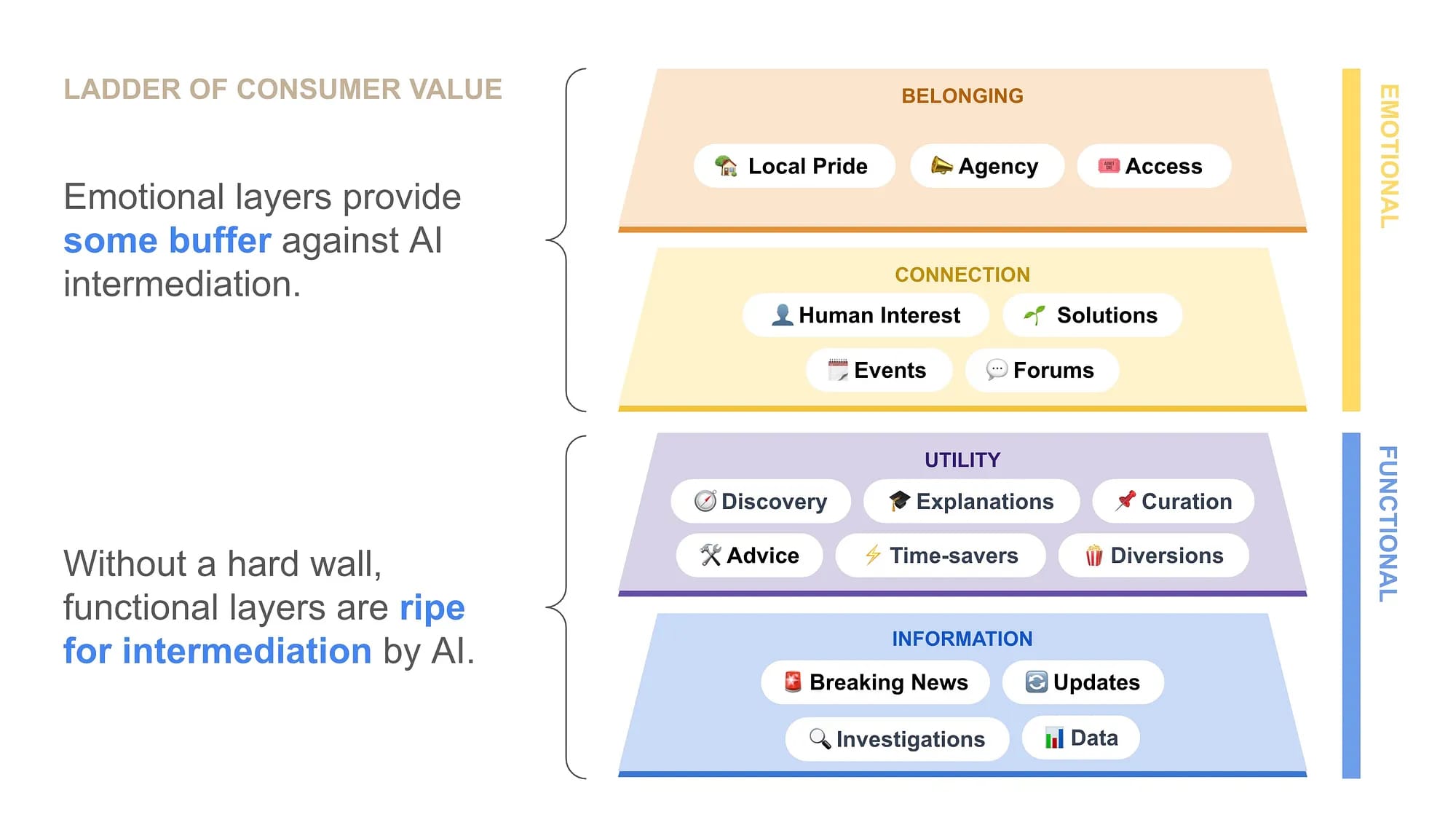
"Emotional layers provide some buffer against AI intermediation." A very clever framing by 🧞Eric Ulken.

#2 | We analyzed 859 newsletters: these are the things publishers keep missing

The 2026 European Enterprise Publisher Newsletter Report is a little gem produced by the Center for Sustainable Media that shows with hard evidence that, across European media, newsletters are "widely deployed, but rarely developed as products". In other words, they are too often a missed opportunity at a time where we can't really afford to miss such opportunities to build direct relationships with our audiences.

#3 | Our newsroom is finding its place in this community

I've been following the development of the 🧩 Tenderloin Voice – a local newsroom serving a San Francisco neighborhood – since its creation less than one year ago, when the newsroom didn't even have a name yet. (Previous episodes in #38 and #40). It's been really special to follow the team in their quest to find their role in the community, driven by a commitment to "serve the people who live and work in the neighborhood", by "empowering community members to tell their stories themselves"

And that's why I loved reading this update by co-founder 🧞Noah Arroyo, sharing what the team achieved over the last six months in helping the community organise to (successfully!) convince City Hall to not cut services that were essential for many vulnerable groups in the Tenderloin.

#4 | How The Markup tracks impact – and how your newsroom can too

The article about impact that I'm writing as a follow-up to the July 1st session on 'Your Impact Questions Answered' is not ready yet because [insert excuse of your choice], so here's a piece from 2022 in which 🧩 The Markup team shared a template to allow any newsroom or organisation to adopt and build upon their tried-and-tested impact-tracking process.

I love that impact stories are shared so prominently on The Markup's website, right below the three most recent stories on the homepage.

#5 | Bringing human-centered design to OCCRP

A great interview with OCCRP's head of journalism products 🧞Fabienne Meijer, in which she talks about her mission to "transform the way our industry works by focusing on journalism as a service" (+1), the benefits of embracing a 'design thinking' approach, and some of her favourites news websites out there.

#6 | What EUobserver's buyout can teach publishers about growing a subscription model

If you're curious to know how things have been at 🧩 EUobserver since the Brussels-based publication was acquired by 🧩 DennΓ­k N in February – TL;DR: pretty well, thank you very much – this one is for you.

#7 | Large Learning Models: why conversations with LLMs are an education in themselves

A curveball at number seven!* It's been a while:

"How an idle conversation with my daughter led to PlotLines, a beautiful tool to map novels, and why the tool itself is less important than the conversations we had with the machine that built it."

A reflection by 🧞Chris Moran on the potential for AI to deepen our relationship with literature – and, I add, why not with journalism as well.

*If you are new-ish here, a "curveball at number seven" is when I decide to use the 7th spot on this list to share something that is a little out there, or only loosely tied to the value proposition of the newsletter, but which is so good that I have to share it.

⭐️ BONUS!

The News Product Alliance just released the programme of the 2026 NPA Summit (Chicago, 21-23 October), and it's full of sessions you may be interested in if you enjoy this newsletter: from "Redesigning news products around community needs", to "Metrics that actually drive your team to strategic impact", and my personal favourite: "Designing experiences that earn trust and drive business growth", aka the intersection of the News Alchemists Venn Diagram.

NPA Summit 2026 β€” Sessions & Speakers
Explore the program for the News Product Alliance Summit β€” sessions and speakers. October 21–23, 2026, Chicago.

Disclaimer: My soon-to-be-wife works at NPA, but she didn't ask me to share this.


The Nieman Lab article on What kind of stories are best at turning local news readers into subscribers?

Not only the most clicked link last week, but this newsletter's fourth most clicked link ever.


🌱 Do you need help growing your media product? I'm your coach.

βš™οΈ Looking for help with newsletter strategy, audience research, or project management? Let's work together.

πŸ€— Enjoy this newsletter? Forward it to someone you think might like it too.