

🔶 7 things I learned from writing a weekly newsletter for one year
For a little over one year, I've been writing the News Alchemists newsletter, a curation of links to make you think and give you hope about reimagining journalism in a people-centric direction.
It's been one of the most rewarding experiences of my career.
In this post, I share 7 things I've learned so far.
1️⃣ You need to make it easy. Like, very easy.
About a decade ago, I spent six months in Southeast Asia on a solo backpacking trip. I decided to write a blog to document the adventure, and I was very committed.
I wrote five posts before the trip even started. Then one post per week in the first month or so. Then the frequency quickly faded as the trip went on, and in the last two months I wrote only once.
Five years later I decided to quit a job without a new one lined up, and what did I do? I started a newsletter to talk about it, of course. But mindful of the blogging experience, I set out to outsmart myself: no long-term commitment I won't be able to maintain, I'm only going to write this newsletter for twelve weeks.
Couldn't even do that. After just four weeks, I couldn't keep up with the every-other-week rhythm. Nine editions in, I stopped writing altogether.
Fast forward to February 2025, when I decided to start writing the News Alchemists newsletter. I knew one thing: if I don't make it easy on myself, this is not going to last.
I needed to 'template it' to avoid staring every week at a blank canvas. Enter the "seven links to make you think and give you hope" format, which makes starting the writing process feel more like a drag-and-drop exercise, bypassing the blank canvas fear entirely.
How do I know it worked? To my amazement, I have not skipped a single week yet, except for when I took time off from work.
In an ultimate exercise of vulnerability (considering that I am more than mildly ashamed of the quality of my writing at the time), I will share the links to the aforementioned travel blog and career-break newsletter with the first five people who ask for them. 🫣
2️⃣ Numbers lie. All the time.
I am a data nerd. I have spreadsheets for everything. The books I read. My finances. How my body weight changes day after day. (I know, it's weird.)
No surprise then that I run my newsletter's operations mostly through a spreadsheet that currently has... [counting]... [still counting]... twenty-four different tabs.
Of those tabs, the one I spend most time looking at and updating is all about the analytics: open rates, click rates, click-to-open rates, number of new subscribers, how many people unsubscribe, etc.
And yet that's exactly the tab that lies to me most often.
Take open rates: they are generally understood to be unreliable because of a mix of privacy and security factors that contribute to somehow overestimating and underestimating open rates at the same time.
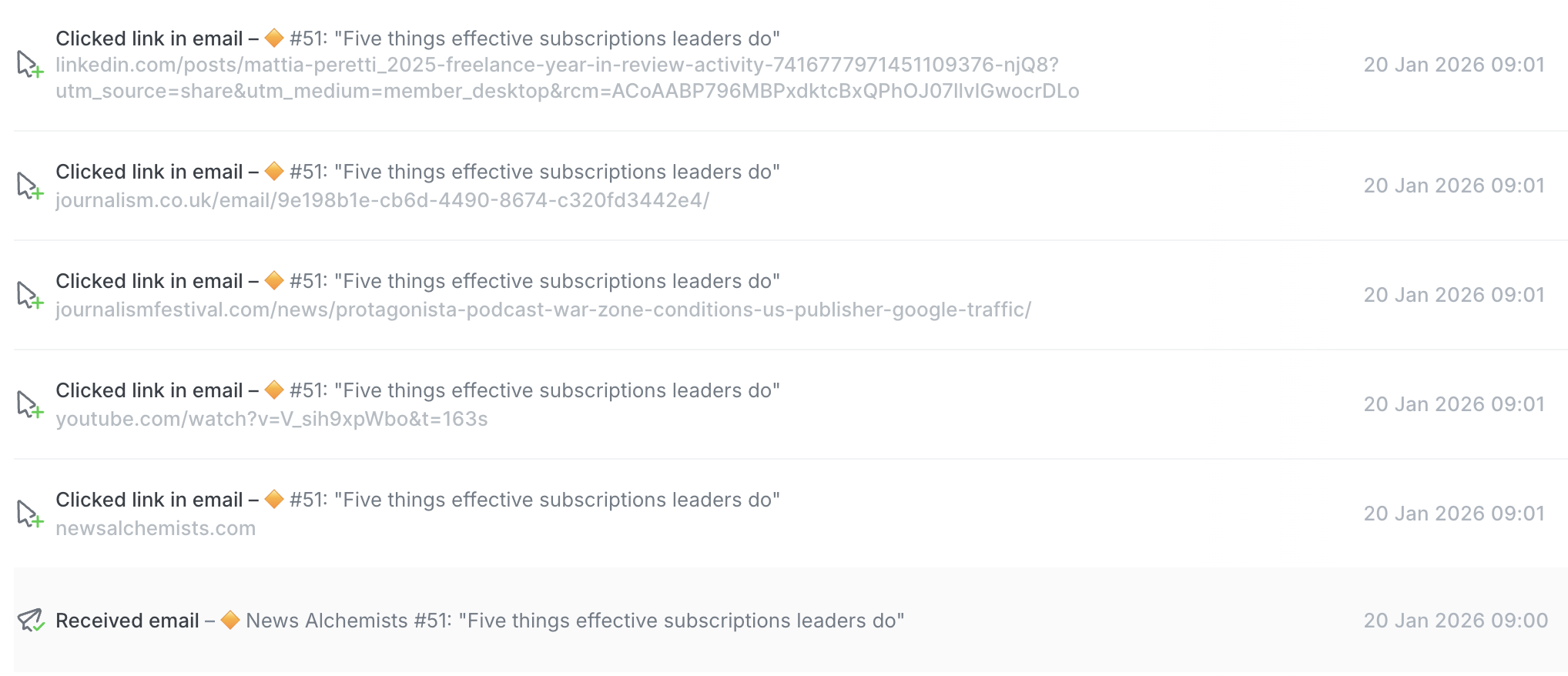
Example: readers who allegedly click on links in your email... without even opening said email.
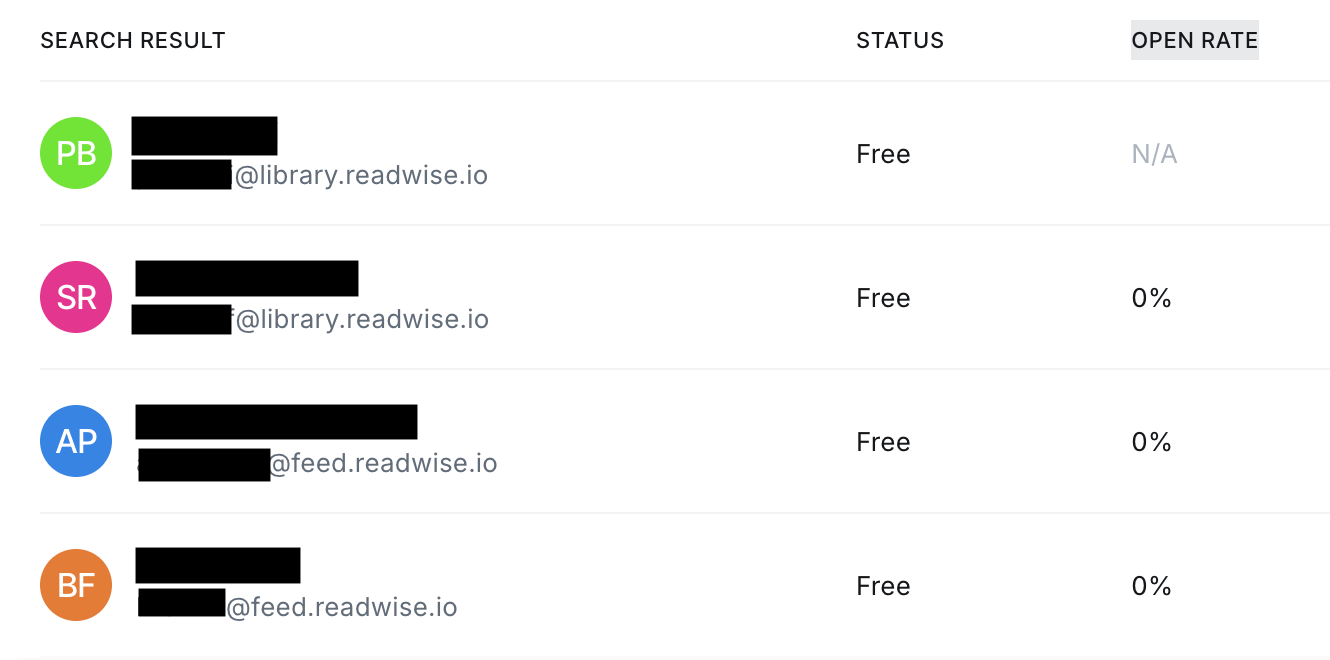
And if readers use a tool like Readwise, good luck to you. No matter how many emails they're opening, the open rate is always 0%:
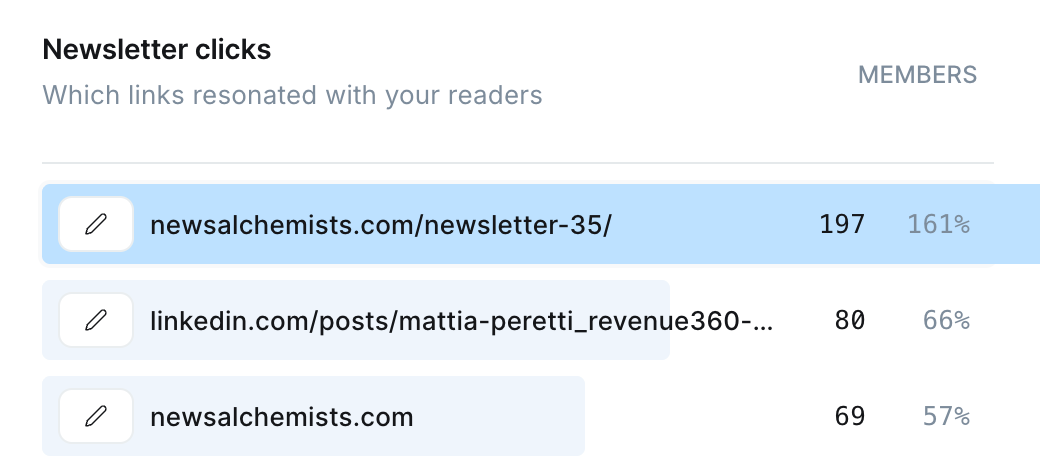
How about click rates, you ask? Exaggerated by bots clicking on every single link as soon as the newsletter lands in someone's inbox.
Even growth numbers lie in their own way.
I've been saying for over two months that I am at "almost 1,000 subscribers". What's happening? Is nobody signing up for my newsletter anymore?
Nop. It's just that Ghost (the CMS I use to send the newsletter) becomes more expensive once you cross the 1,000 threshold, so I started cleaning the mailing list more aggressively. What would be the point of paying extra for inactive subscribers who haven't opened any emails in over twelve months?
Makes sense, right? And yet it looks like the newsletter has stopped growing, which can be detrimental when trying to attract advertisers.
The moral of the story is: whether you're writing a newsletter or following someone who does, take numbers with a pinch of salt. Focus instead on the quality of the content, on the engagement with readers, and on the value the newsletter creates for the people who read it and engage with it.
3️⃣ There's so much more to do than "writing it"
The title I gave to this article is a little misleading: the actual writing amounts to no more than 40% of the time I spend on the newsletter. The other 60% includes:
- Researching and saving stuff to include in the newsletter;
- Monitoring its performance in the CMS;
- Promoting the newsletter on social media (mostly LinkedIn) and other channels;
- Reading about new trends, tools, and strategies to grow and optimise newsletters;
- Looking for sponsors and advertisers (Is that you?);
- Keeping the newsletter's website clean and tidy;
- Constantly optimising the infrastructure that powers the newsletter behind the scenes;
- And so. Much. More.
The most time-consuming aspect about writing a newsletter running a newsletter business though? Engaging with readers. And yet...
4️⃣ There is no such thing as too much interaction with your readers.
I decided from the beginning that I didn't want to just write and send into the void. A newsletter that advocates for being more people-centric can only succeed by being people-centric.
I wanted to get to know my readers, talk to them, learn how the newsletter could be helpful to them. I wrote that this is the most time-consuming thing I do, but it's also the most rewarding one.
I get frequent positive feedback that encourages me to keep going. I uncover needs I would have never been able to identify by myself. I get so many ideas for things I could do to improve the newsletter – or for services I could add to the newsletter, such as coaching – that I end up feeling frustrated for not having enough time for all of them. That's a great problem to have!
But interactions with readers rarely just happen – although it's wonderful when they do. I learned that it's important to be intentional about initiating them. For example:
I send an email to all new readers when they subscribe. I introduce them to the newsletter and ask them what made them want to sign up. One in four people replies back, and their messages are always kind and insightful:
It is not very common to come across a hopeful newsletter, so I thought I might want to receive that dose of hope once a week.
I am currently working on relaunching my own environmental newsletter following a break, and looking to get inspiration about how to do it well.
I was at a dinner with fellow journalists who are thinking differently from the mainstream, and they said I should be following your newsletter. So here I am.
I email readers when I notice inactive accounts, or readers who signed up with multiple accounts. Boring housekeeping on the surface, but even those trigger wholesome interactions and deepen engagement:
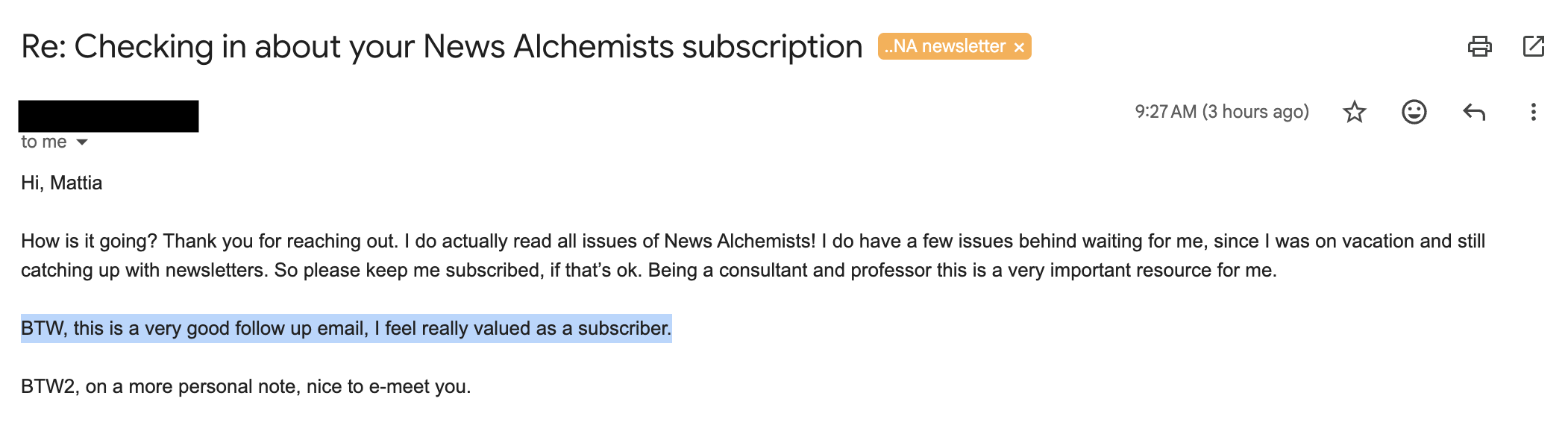
And I message readers when they unsubscribe, which often results in a valuable reminder that people's circumstances change and information overload is real:
Thank you for reaching out, I have appreciated the personal connection you have extended to your subscribers. I originally subscribed because I was interested in learning more about the future of journalism, especially independent, reader-supported journalism. But unfortunately, I can't keep up with all of the newsletters in my inbox, so time to make cuts.
I’m doing quite a bit of a clean-up of my inbox and all the newsletters I’m subscribed to at the moment, as I’m shifting my focus, both themes and geographies. The idea is to be more intentional about what lands in my email.
Nothing like interacting with people to keep you people-centred 🙃
Engaging with your readers is not time consumed but time invested. It pays off.
5️⃣ These three things bring in new subscribers more than anything else.
Look, the apparent stagnation of my audience's growth that I mentioned in the second lesson might be artificial, but this is not to say that growth is easy. It's not.
On average, I gain 11 new subscribers per week. That's net growth: new subscribers minus lost ones (unsubscribes, disabled accounts, or accounts I delete for lack of engagement after a fair warning).
Eleven is the average but growth is not even. Organic growth is especially slow, while three things contribute more than anything else to bring in new subscribers:
- When I give a talk at a conference – even better if IRL – or a workshop for a newsroom (reach out if you're interested in one);
- Someone – a reader or anyone else – recommends my newsletter to their audience or network, encouraging people to sign up;
- And most of all, when I publish what in marketing jargon is called a 'lead magnet': a piece of content or a product that makes more people find out about the newsletter and entice them to subscribe. For example, this 'Freelance Year in Review' I published in January:
 Mattia Peretti
Notice the irony / structural issue here: to grow the audience of the newsletter you write, you end up spending a lot of time writing... something else.
Less impactful in quantitative terms but incredibly rewarding: when someone subscribes because an existing reader told them to do so 🫶
Tell me: What else were you hoping to see in this post? What would you like me to share in the next what-I've-learned article?
6️⃣ Monetisation is very hard. (Shocker, I know.)
In the lead-magnet piece that I just mentioned, I wrote that the newsletter accounted for 5% of the revenue I made in 2025 as an independent consultant, writer and coach – through sponsorships, readers' donations, and speaking engagements.
I wasn't expecting to make any money with the newsletter in its first year so that's great. But it also shows how hard it is to monetise this work:
- Only 7 editions out of the 56 I sent so far had a sponsor – that's just 13% – and this year I haven't managed to find one yet.
- The donations campaign I run last December went quite well, raising more money than I expected. But donations came from only 18 of the almost 900 subscribers I had when the campaign launched. That's just 2%. (If you're one of those 18 people, this is a good occasion to remind you how much your donation meant to me. Thank you.)
- Across 10 months last year (the newsletter started in late February), this work led to only 3 paid speaking engagements – essentially one per quarter.
Don't take any of the above as a complaint. I'm very grateful to sponsors, readers who made a donation, and readers who trusted me to have something interesting to share with their colleagues or audiences. It's on me to grow those numbers by improving the newsletter and all other News Alchemists products and services.
If I'm sharing this, it's to show that the economics of running an independent newsletter business are challenging, no matter how much time and effort you put into it.
Sure, someone makes it and turns a newsletter into a media empire (not that that's my goal). Just don't fall into the trap of thinking that because they made it, you should make it too and you're failing if you don't.
7️⃣ Readers write your best marketing copy. You just need to ask them.
And if I didn't make it abundantly clear already that my readers are awesome: they write the best marketing copy too.
In a reader survey I shared last year (yes, it' still open!), I asked readers how they would describe what the News Alchemists newsletter is about. Their answers have shaped how I talk about it ever since:
A friend who challenges my most conventional thinking about the relationship between news/journalists and the audience of news consumers.
Imagining and celebrating the news innovations that put audiences and communities first
Best practices and insights on how journalists are thinking (and need to think) about audiences, information needs and impact in different ways, provoking good conversations for me and my organization.
A guide to journalism innovators who are creating a better news ecosystem.
Reimagining a future for journalism that looks at audiences as a core part of its mission and community, not “just” as consumers.
Yes, my readers are the best. 🧡
How you can help News Alchemists grow – a recap:
📢 Sponsor the newsletter, or advertise your services through a classified ad.
🌱 Let me coach you: I'll help you find clarity and build your media product with confidence.
🙋♂️ Hire me to work on your team's next big project. I'm currently looking for a 2-3 day/week consulting engagement over several months. I can help with project management, audience research, facilitation, and learning design. The consulting I do directly supports the sustainability of the newsletter.
🔝 Share the newsletter with anyone you think might enjoy it – or forward them this article!
Member discussion