🔶 News Alchemists #63: The Circulator Model
Hello, and welcome back to the News Alchemists newsletter!
And a special first welcome to new subscribers from NHK, Outlier Media, Forbes, Public Media Network, Rappler, the University of Vermont, and all of you brave souls working independently.
Here’s a familiar story we tell ourselves in this industry: newsrooms share fact-based content, "the audience" consumes it, and the world magically gets better because informed citizens make better choices.
It's a comforting theory. It's also a failing one.
Informing the public is not enough if we don't also empower people to do something with that information, together.
Starting from this awareness, newsrooms all over the world are trying to do things differently. Just two examples:
🧩 Mutante invites the public to participate in conversation cycles, where difficult topics such as sexual violence, workplace abuse, and mental health are discussed, understood, and addressed together rather than just reported on;
🧩 The Green Line produces 'action journeys' rather than stories – with each action journey made of four parts: an explainer, a feature, a community event, and solutions/resources.
These approaches often require journalists to embrace different roles than what they might be used to – often acting as 'conveners', as the American Press Institute highlighted in one of the very first links I shared in this newsletter.
The premise is that to achieve real change, we must examine more closely how information flows, rather than assuming that broadcasting it online will inevitably yield positive results. We should also remember that the act of processing the news is much more effective when done collectively rather than individually.
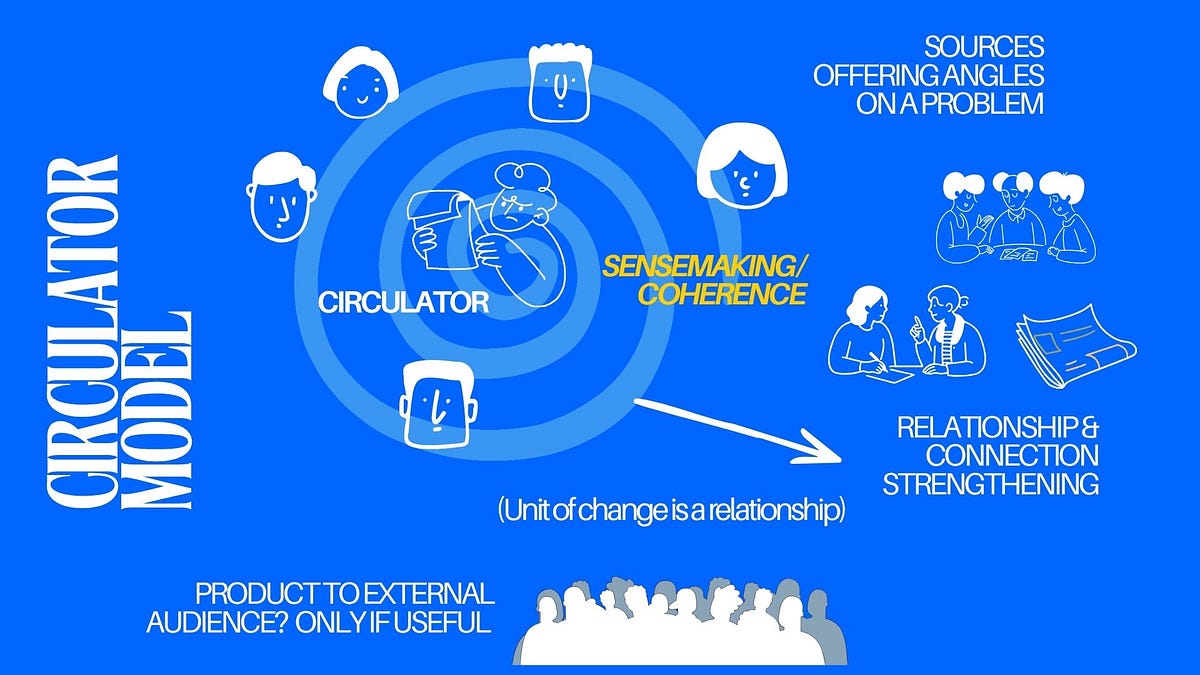
🧞Jennifer Brandel, a pioneer of people-centricity, suggested in a recent article a framework that pulls these ideas together in an elegant way: The Circulator Model.

This is a follow-up on another article by Jennifer that I shared weeks ago: "Is it time for journalists and newsrooms to become something else?"
The circulator is that "something else". Here's the premise of the model:
Imagine a newsroom does a story on the problem of sexual assault in its community. The reporter talks to police, social workers, survivors, prosecutors and medical examiners to get a rounded view of the issue. They synthesize everything into a well-reported piece. It goes out into the world. But here’s what typically doesn’t happen: the reporter doesn’t invite those sources into conversation with each other to help understand and patch the gaps in the system.
Jennifer asks: "Could change or solutions from this reporting suddenly arise from a disorganized, attention-challenged audience?" And I agree with her answer: it's highly unlikely.
A journalist or a newsroom acting as a circulator "doesn't just broadcast information outward to a disorganized audience; they ensure knowledge moves through the system to the people who can actually do something with it."
The focus is not on producing stories, but on "strengthening the connections between the people and knowledge in a field."

What's critical is that this is not a metaphor or an untested theory: in different shapes and under different names, the circulator already exists – in journalism (as we've seen with the earlier examples I mentioned, and in others referenced by the article) and in other fields that essentially function in this exact way, like peacebuilding.
Jennifer acknowledges that the Circulator Model is "an attempt to name one piece of what’s needed", not a tried-and-tested solution. It raises more questions than it answers, and its practical implementation at scale in journalism organisations needs further exploration.
But it moves us in the right direction.
My new favourite interview format
In 2015, Jennifer Brandel founded Hearken to promote 'public-powered journalism', a methodology built on the idea that "listening leads to stronger relationships, deeper engagement, better decisions, and enables individuals to make an outsized positive impact in the world."
Last month, Hearken was acquired by Indiegraf, and to immortalise the moment, Jennifer wrote another gem: an interview between her current self and her younger self that was just launching Hearken at the time. 100% worth your time, I promise.
No seven links this week as you've probably figured out already. As always, let me know if this disappoints you, or if you like single-story deep dives like this one. The thumbs-up and thumbs-down at the bottom of the email are the easiest way to tell me what you like and don't like 😉
See you next week!
And the most clicked link from the previous edition is...

⇲ The LinkedIn Corner
A section of this email in which I highlight LinkedIn posts written by newsletter readers that, for different reasons, may not make it to the 7-links league, but are still interesting to share. This week... takeaways from Perugia of course:
- Goksen put together her list of 10 takeaways, including nuggets about engagement and revenue diversification;
- Roxana shared five takeaways, with my favourite being: "Being together is not optional anymore."
- Marcela noticed a palpable mood shift compared to last year: from freaking out to taking back control.
🤗 Enjoy this newsletter? Forward it to someone you think might like it too.
🌱 Need help growing your media product? Book a free chat and let's talk.
⚙️ Looking for help with newsletter strategy, audience research, or project management? Let's work together.
📢 Wanna promote your products? Sponsor the News Alchemists newsletter.
Member discussion